



.png)



.png)

2026 Complete VCE Education.
All rights reserved
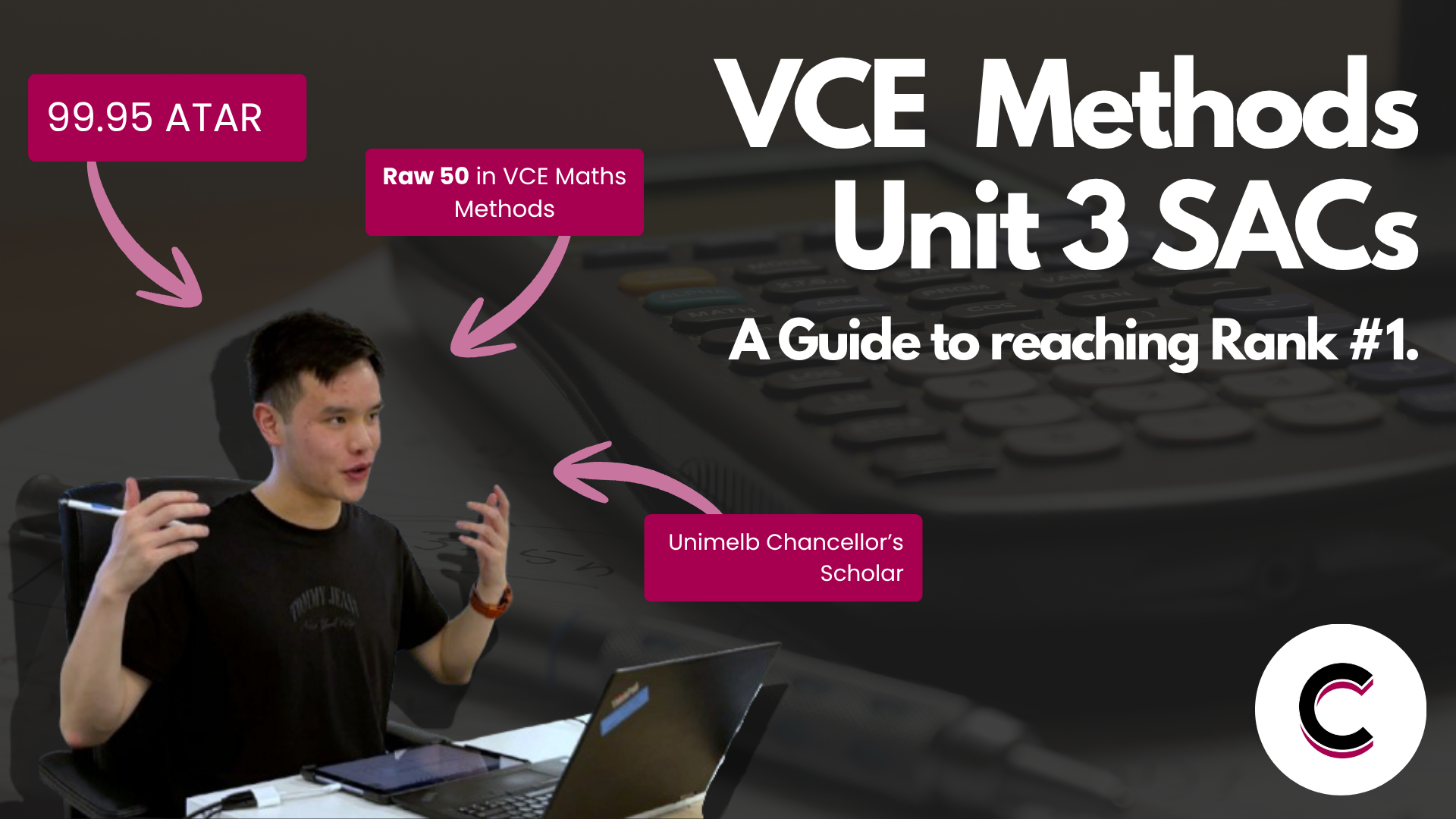
Achieve Rank #1 in the Unit 3 Maths Methods SAC with this Simple Guide
Want to hear tips on how to beat the rest in the Maths Methods Unit 3 SAC? Read through our comprehensive guide written by 99.95 ATAR, Raw 50 Maths Methods tutoring master as he shares his own unique experiences and techniques...
How do I prepare for VCE Maths Methods Unit 3 SACs?
The most important part of preparation for any Mathematical Methods SAC/exam is undoubtedly doing practice. More practice is the only way to get better at doing questions faster and more accurately. Don’t just practice with textbook questions – SAC style questions are more demanding, involving interpretation of a model within a context and analysing functions of varied types where the approach sometimes is less clear than a textbook question
Practicing with your CAS as much as possible is also very beneficial – you want to become innately familiar with how to use the CAS and feel comfortable inputting commands in easily without error and interpreting the results given
By practicing more, you also gain the added bonus of being more aware of what to expect come SAC time. It can be a shock opening a SAC or exam and realise that some of the questions are unlike anything you have ever seen before. This also holds true for time management – practicing under timed conditions and assessing your work under these will help you get a better picture of how you might do come SAC day; trying to do everything different on the day rarely works out, and simulating the conditions of the SAC as accurately as possible at home is key to success. If you start working on your SAC and it feels just like a practice simulation at home, then you’ve done well.
Putting in the time to develop a bound reference can also be very handy. The most important part of a bound reference is not having all of the subject content in it, but rather having a guide for you to fall back on when you are stuck. Good things to include are worked solutions to problems you have
previously struggled with, and some reminders to yourself on mistakes you commonly make. I personally viewed my bound reference as a way for pre-
exam me to communicate in the exam room with in-exam me, and included things I thought would be good to hear/be reminded of while in the exam room working on the questions.
Investigation-style SACs can also come with their own hurdles where you have to design a modelling function yourself. These will draw on all of the Mathematical Methods experience you have accumulated throughout Unit 3:
- An awareness of the appropriate function type(s) for the problem
- The ability to use various methods, such as exact and numerical solutions, to obtain an appropriate modelling function
- The ability to use various methods to analyse the modelling function itself in context and answer various questions in context
For questions like this, you should slow down and carefully consider all the aspects of the problem. Try to use some common sense/natural reasoning too! Mathematics isn’t just abstract nonsense; it tries to describe the natural world as best it can, and models should reflect that.
Some key skills to work on for Area of Study 1 in Unit 3 VCE Maths Methods are:
- Being able to sketch the graphs of common functions (polynomial, exponential, circular, logarithmic functions) with reasonable accuracy, relying on key features such as axis intercepts, stationary points, and asymptotes to guide the shape
- Being able to determine the effect of transformations on a given graph
- Being able to deduce sequences of transformations taking one graph to another
- Interpreting modelling problems, especially the relation of parameters to real-world variables (e.g. the period of a trigonometric function and what it represents), and working with real-world concepts such as length, area and volume
Some key skills to work on for Area of Study 2 are:
- Finding inverse functions
- Understanding the different results of simultaneous linear equations
- General solutions for trigonometric equations
- Solving equations involving polynomials, including in other contexts such as exponential and logarithm equations
- Determining the implied domain and range of a composite function
Some key skills to work on for the differentiation aspect of Area of Study 3 are:
- Differentiating functions of all types: polynomial, exponential, circular, logarithmic functions and combinations/compositions of these
- Using differentiation to determine the coordinates of stationary points and points of inflection, and the equations of tangents and normals
- Using differentiation to solve optimisation problems (i.e. minimisation/maximisation) in all sorts of contexts
Some generic skills that are of use include:
- General fluency with algebra (doing algebraic manipulations quickly and accurately)
- Efficient use of the CAS to speed up working on problems, including awareness of its varied functions and how to use them, and recognising when to use e.g. calculator vs graphing pages to solve a problem faster
- Recognising when to use different problem-solving strategies, e.g. when a question can be broken down and simplified with some algebraic work or logic before jumping to the CAS
- Practice! Confidence helps a lot, as does experience with different question types
Want even more free VCE Math and Science tips?
Don’t miss out, subscribe below to access even more free resources! By joining our newsletter, you will stay updated with expert tips, new study materials, and special offers.
Interested in taking your learning further? Enrol in our weekly VCE Maths Methods tutoring classes to unlock a comprehensive bank of practice questions, revision sets, practice SACs and full mock examinations designed to test and strengthen your knowledge — all supported by our highly experienced Raw 50 VCE Maths Methods tutors.
Contact us today and book your free 1-week trial class to find out how we can help you achieve your goals!


