


Mastering Calculus: The Chain Rule - VCE Maths Methods

Struggling with the chain rule? Learn the shortcuts, avoid the most common mistakes, and master this essential VCE Maths Methods skill with confidence.
Written by
Asel Kumarasinghe
Published on
June 19, 2026

In this series of blogs, we will cover the key principles underpinning one of the most challenging topics in VCE Maths Methods – calculus. This first blog will discuss the chain rule, an important rule which is utilised for a variety of function types, including when it can be used, how it is applied. We will explore two methods of applying the chain rule with some worked examples.

Overview of the Chain Rule:

The chain rule is used to differentiate composite functions. You may recall from earlier topics that a composite function is essentially a ‘function within another function’, and is in the form 𝑓(𝑔(𝑥)). An example of a composite function is (𝑥 + 1)^6, where 𝑔(𝑥) =𝑥 +1 and 𝑓(𝑥) = 𝑥^6. In other words, the function 𝑔(𝑥) is substituted into the function f(𝑥).

There are two forms of the chain rule as shown below:

Leibniz notation:
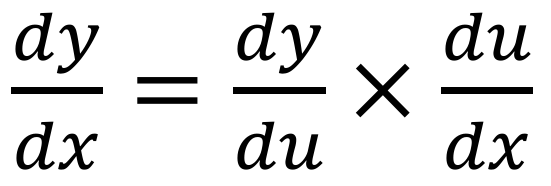
Function notation: (aka Newton Notation)

For the purposes of this blog, we will utilise Leibniz notation, however you may use function notation instead if you prefer. There are two ways in which the chain rule can be applied; the classical method using a ‘u’ substitution and a faster shortcut method.

Method 1: ‘u’ substitution

The classical method of performing the chain rule involves the following main steps. We will illustrate this using the example 𝑦 = (2𝑥^3 + 1)^5.
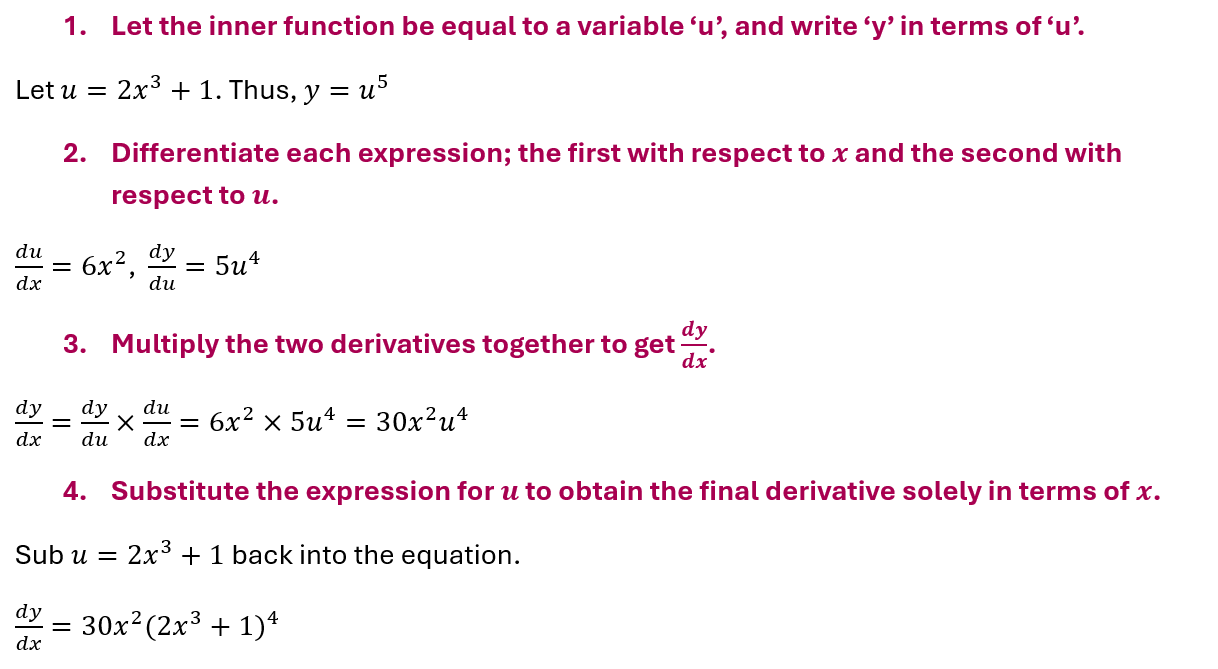
Example:
Method 2: The Shortcut

There is a faster way of applying the chain rule utilising fewer intermediate steps. The process is as follows, using the example 𝑦=(1+tan(𝑥))^10.
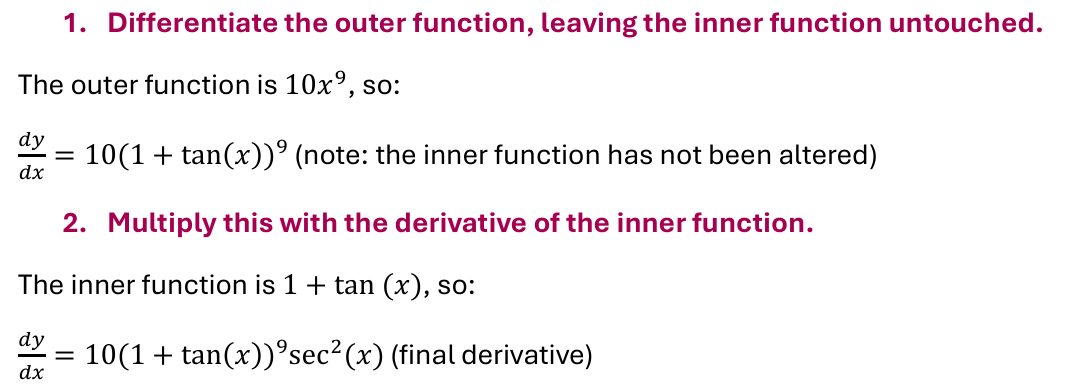
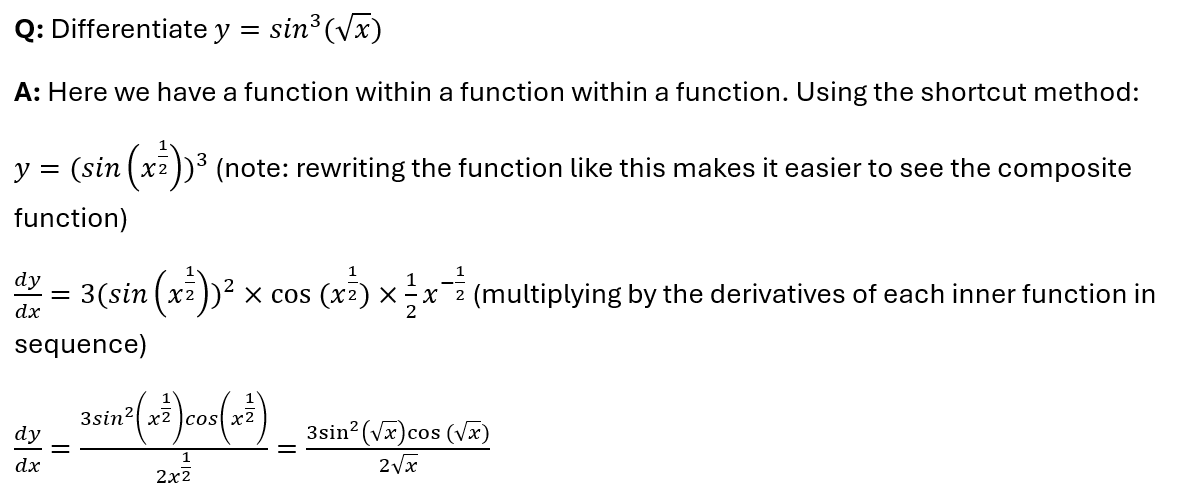
The benefit of this method is that it can be efficiently used for more complicated functions, such as those where the chain rule would need to be applied more than once. It is important to start with differentiating the outermost function and then ‘zooming in’ and multiplying it with the derivatives of each subsequent inner function.

Example:
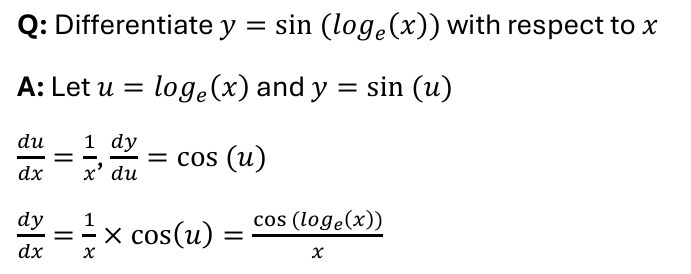
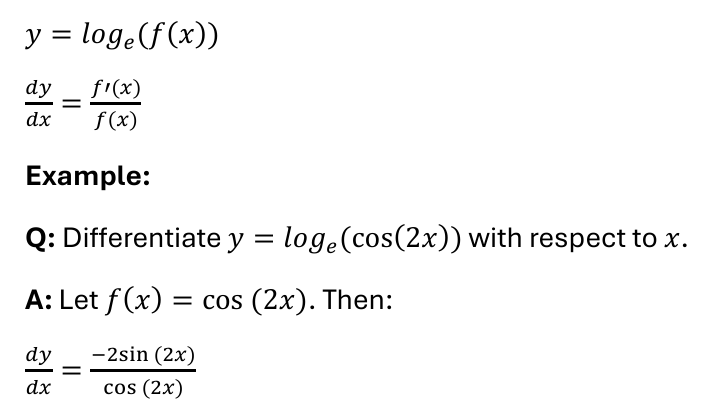
Shortcut for differentiating log functions:

In composite functions where a logarithm is the outer function, the following shortcut may be useful...
With greater practice, you will become fluent in utilising the chain rule efficiently for a variety of functions, which will be beneficial in the calculator free exam paper as well as some calculator active multiple choice questions, such as finding derivatives of functions with 𝑓(𝑥) in them. In our next blog, we will be covering yet another important rule of calculus – the product rule.

Don’t miss out, subscribe below to access even more free resources!

By joining our newsletter, you will stay updated with expert tips, new study materials, and special offers. Interested in taking your learning further? Enrol in our classes to unlock a comprehensive bank of practice questions, revision sets, and a practice SAC designed to test and strengthen your knowledge — all supported by our experienced tutors.

Free VCE Science and Maths Resources
No spam. Just the latest blogs and tips, practice questions, and exclusive guides directly to your inbox - no strings attached.
We care about your data in our privacy policy.
Thank you! Your submission has been received!
Oops! Something went wrong while submitting the form.
Looking to pair Science Success with elite Mathematics Support?
From Victoria's top VCE Physics specialists comes Melbourne's Premier VCE Maths Methods Tutoring Program.

Interested in more?

Take a read through our most recently published blogs...
VCE Resources - AOS Materials

VCE Physics Unit 3 AoS 1 - Motion Introduction

Are you making a mess of motion? Our completely free, comprehensive introduction to U3A1 created by expert tutor Asel can help guide your way through this extensive topic.
Logan Divers
December 19, 2025
2
min read
Student Stories and Insights

How to Succeed in VCE Physics: 3 Major Challenges Solved

These are the three most common challenges we see students struggle with - and our advice on how to overcome them!
Logan Divers
December 11, 2025
4
min read
Student Stories and Insights

Mastering Motion: Four Tricky Pitfalls for even the Best Students studying U2A1 and U3A1

Motion can be a tough topic covering a wide range of bases - but what are the most common mistakes even this subject's brightest students can make? Read this blog to learn more about the errors you may very well be familiar with in this Area of Study.
Logan Divers
January 2, 2026
6
min read
VCE Resources - AOS Materials

VCE Physics Unit 4 AoS 1 Light, Matter and Special Relativity: Essential Revision Materials

Puzzled by the dual wave-particle nature of light and matter? Bewildered by the fact that length and time can be different for different observers? Our detailed U4A1 introduction, summary, formula sheet and diagnostic quizzes, crafted by expert tutors Asel, Logan and Sav, will help illuminate these complex concepts.
Asel Kumarasinghe
August 3, 2025
12
min read
Student Stories and Insights

Four Mistakes That Can Kill a Perfect VCE Physics SAC or Exam – And How to Fix Them

Want to avoid common exam traps in VCE Physics (Year 12)? From misused constants to running out of time, this guide breaks down four critical mistakes that can cost you marks — and shows you exactly how to fix them. Perfect for SACs, practice papers, and the final exam.
Logan Divers
June 28, 2025
6
min read
VCE Resources - Practicals

How to Master the VCE Practical Investigation: A Complete Guide

Master your VCE Physics Scientific Investigation SAC (Year 11 & Year 12) with our complete guide. From forming a hypothesis to designing experiments, analysing errors, and building your poster, this step-by-step resource simplifies every stage — perfect for Physics, Chemistry, or Biology.
Logan Divers
June 12, 2025
10
min read
VCE Resources - AOS Materials

VCE Physics Unit 1 AoS 2 - Nuclear Physics Full Summary Notes

Struggling with VCE Physics Unit 1 Area of Study 2: Nuclear Physics (Year 11)? From radioactive decay to nuclear stability and fission, our free summary notes simplify every key concept — perfect for revising or building your own cheat sheet.
Asel Kumarasinghe
March 25, 2025
2
min read
Picture of Kevin TeachingVCE Physics tutor looking up