





2026 Complete VCE Education.
All rights reserved
Mastering Calculus: The Chain Rule - VCE Maths Methods
Struggling with the chain rule? Learn the shortcuts, avoid the most common mistakes, and master this essential VCE Maths Methods skill with confidence.
.png)
In this series of blogs, we will cover the key principles underpinning one of the most challenging topics in VCE Maths Methods – calculus. This first blog will discuss the chain rule, an important rule which is utilised for a variety of function types, including when it can be used, how it is applied. We will explore two methods of applying the chain rule with some worked examples.
Overview of the Chain Rule:
The chain rule is used to differentiate composite functions. You may recall from earlier topics that a composite function is essentially a ‘function within another function’, and is in the form 𝑓(𝑔(𝑥)). An example of a composite function is (𝑥 + 1)^6, where 𝑔(𝑥) =𝑥 +1 and 𝑓(𝑥) = 𝑥^6. In other words, the function 𝑔(𝑥) is substituted into the function f(𝑥).
There are two forms of the chain rule as shown below:
Leibniz notation:
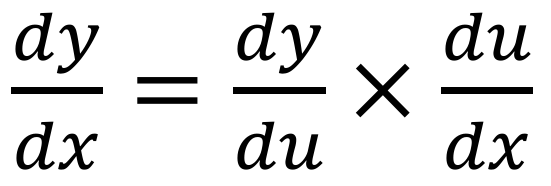
Function notation: (aka Newton Notation)

For the purposes of this blog, we will utilise Leibniz notation, however you may use function notation instead if you prefer. There are two ways in which the chain rule can be applied; the classical method using a ‘u’ substitution and a faster shortcut method.
Method 1: ‘u’ substitution
The classical method of performing the chain rule involves the following main steps. We will illustrate this using the example 𝑦 = (2𝑥^3 + 1)^5.
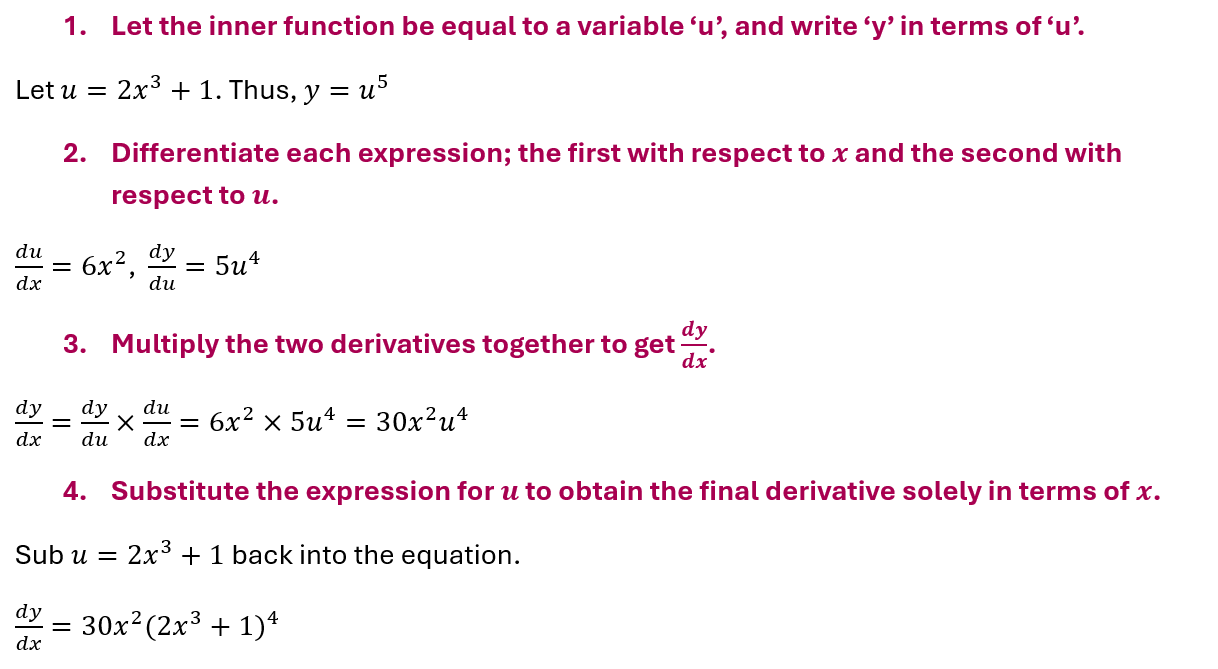
Example:
Method 2: The Shortcut
There is a faster way of applying the chain rule utilising fewer intermediate steps. The process is as follows, using the example 𝑦=(1+tan(𝑥))^10.
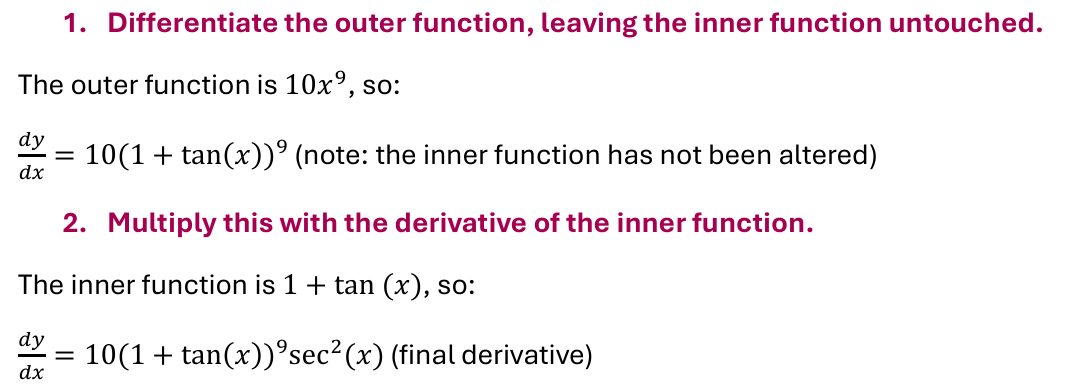
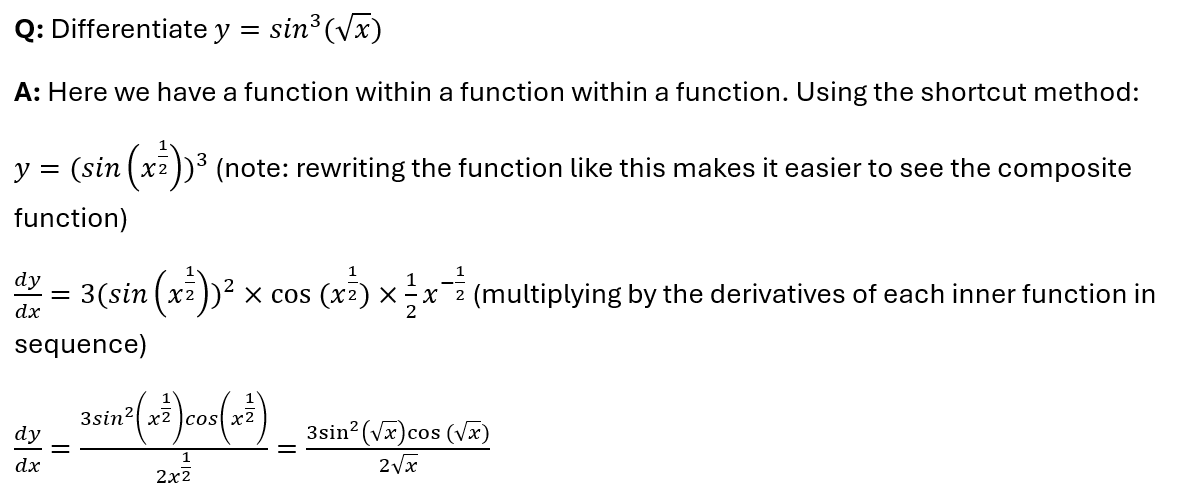
The benefit of this method is that it can be efficiently used for more complicated functions, such as those where the chain rule would need to be applied more than once. It is important to start with differentiating the outermost function and then ‘zooming in’ and multiplying it with the derivatives of each subsequent inner function.
Example:
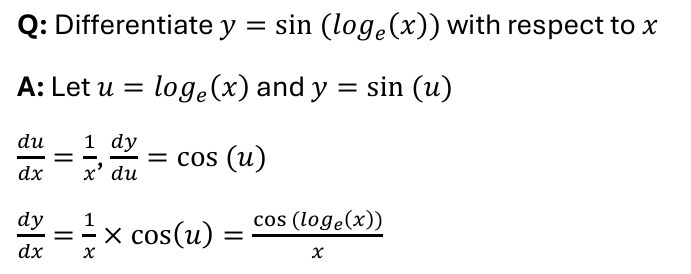
Shortcut for differentiating log functions:
In composite functions where a logarithm is the outer function, the following shortcut may be useful...
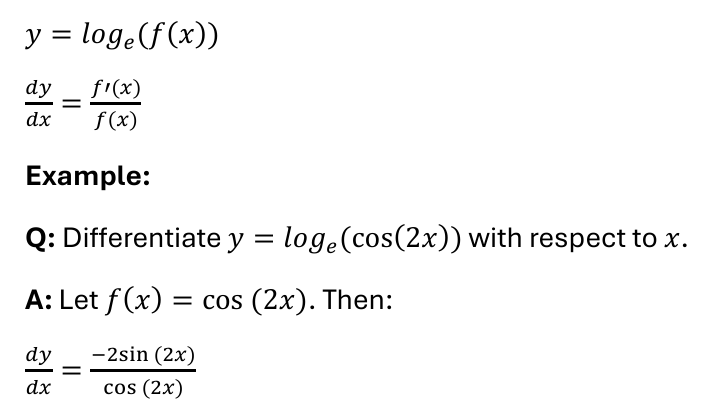
With greater practice, you will become fluent in utilising the chain rule efficiently for a variety of functions, which will be beneficial in the calculator free exam paper as well as some calculator active multiple choice questions, such as finding derivatives of functions with 𝑓(𝑥) in them. In our next blog, we will be covering yet another important rule of calculus – the product rule.
Don’t miss out, subscribe below to access even more free resources!
By joining our newsletter, you will stay updated with expert tips, new study materials, and special offers. Interested in taking your learning further? Enrol in our classes to unlock a comprehensive bank of practice questions, revision sets, and a practice SAC designed to test and strengthen your knowledge — all supported by our experienced tutors.


