



.png)




2026 Complete VCE Education.
All rights reserved
2024 VCE Physics Study Design Change - Essential Insights
2024 VCE Physics Study Design Change - Essential Highlights

As most of you are probably aware, VCAA has implemented a new study design for VCE physics. The new study design can be found here.
Having a solid understanding of the study design is crucial for success in VCE physics, as it contains dot points under each area of study detailing exactly what you need to know for the exam. It is also important to be aware of the changes made to the study design, especially when doing past exams from older study designs. Having this awareness will help you identify which past exam questions are no longer relevant to the current study design, and help you determine the new topics for which there may be limited past exam questions.
For units 1&2, the accreditation period for the new study design is 2023-2027, whereas for units 3&4, the period is 2024-2027. The new study design comes with a plethora of changes, including altered weightings for SACs (school-assessed coursework) and exams, re-ordered areas of study and new dot points. Here, I will compare the previous and new study designs, to help you get a better idea of the changes that have been implemented.
New assessment weightings
The first major change is the altered weightings of SACs and assessment tasks for units 3&4:
Thus, the combined weighting for SACs across units 3&4 has increased to 50%, and the weighting of the exam has decreased to 50%, so this change will hopefully take off some of the pressure from the final exam. However, increased emphasis will be placed on unit 3 SACs.
Terminology
Unlike the previous study design, the new study design clarifies some of the terminology that will be used in VCE physics to avoid confusion. Here are the main points:
- The term ‘force due to gravity’ will be used, with the symbol Fg. No reference will be made to ‘weight’ or ‘weightlessness’, so it is best to avoid using these terms.
- Forces will be described as the force on an object by an object, rather than the force of an object. The use of the ‘on___by__’ structure reduces confusion, as it clearly demonstrates that objects do not ‘possess’ force, but rather forces act on objects. The symbol that will be used is Fon A by B.
- The term ‘normal force’ will be used to describe the perpendicular force that acts when two surfaces are in contact. The terms ‘reaction force’ and ‘normal reaction force’ will no longer be used, as they create the misunderstanding that the normal force is a reaction force according to Newton’s Third Law (however this is not always the case).
The study design also clearly lists the accepted definitions for measurement terms such as accuracy, precision, uncertainty, repeatability, reproducibility and more. Make sure you have a read of the study design and take note of these definitions. Rules regarding significant figures and types of errors (random and systematic) have also been clearly described in the new study design.
Content Changes
Units 1&2:
Here, I will summarise the changes to units 1&2 of VCE physics. The major changes include the addition of electromagnetic waves and light to unit 1 area of study (AOS) 1, the swapping of unit 1 AOS 2 and AOS 3, as well as the introduction of new options in unit 2 AOS 2.
Unit 1 AOS 1: How are light and heat explained?
Added:
- Electromagnetic waves
- Regions of the electromagnetic spectrum and uses in society
- Wave nature of light (refraction, dispersion)
- Formation of optical phenomena (rainbows, mirages)
- Light transmission through optical fibres
Removed:
- Zeroth and First Laws of Thermodynamics
- Stefan-Boltzmann Law
Kept:
- Heat transfer processes (conduction, convection, radiation)
- Q=mc∆T (raising temperature)
- Q=mL (changing state)
- Wien’s Law
- Electromagnetic spectrum
- Climate change and global warming applications
Unit 1 AOS 2: How is energy from the nucleus utilised? (Unit 1 AOS 3 in previous study design)
Added:
- Effects of alpha, beta and gamma radiation, radiation dosage (absorbed, equivalent and effective dose)
- Medical radioisotopes in therapy
- Fission chain reactions:some text
- Effect of mass and shape on criticality
- Neutron absorption and moderation
- Viability of nuclear energy in Australia
Removed:
- Origins of atoms (Big Bang theory, development of universe)
- Subatomic particles (eg. neutrino, positron, Higgs boson, quarks, leptons, hadrons, mesons and baryons)
- Antimatter
- Production of light through acceleration of charges and electron transitions
- Synchrotron
Kept:
- Nuclear stability in relation to forces in nucleus (strong nuclear force, weak nuclear force, electrostatic forces)
- Radioactive decay and half life
- Alpha, beta, gamma radiation
- Decay series diagrams
- Mass-energy relationship (E=mc2)
- Nuclear fission and fusion
- Binding energy curve
Unit 1 AOS 3: How can electricity be used to transfer energy? (Unit 1 AOS 2 in previous study design)
Basically the same as Unit 1 AOS 2 in the previous study design.
Kept:
- Charge, current, potential difference, energy, power
- Electrical circuits (parallel and series)
- Light bulbs, diodes, thermistors, LDRs, LEDs and potentiometers
- Electrical safety in the home
Unit 2 AOS 1: How is motion understood?
Basically the same as previous study design.
Added:
- Investigate the application of motion concepts through a case study (eg. sport, vehicle safety, a device or structure).
Kept:
- Equations of constant acceleration
- Momentum, impulse, conservation of momentum
- Forces, Newton’s Laws
- Vectors and scalars
- Energy and work done (gravitational potential energy, elastic potential energy, kinetic energy)
- Power, efficiency
- Torque and equilibrium (translational and rotational)
Unit 2 AOS 2: Options
Same options as the previous study design, with a few additional options.
Added:
- How does physics explain climate change?
- How do forces act on structures and materials?
- How is physics used in photography?
- How can physics explain traditional artefacts, knowledge and techniques?
- How does physics explain the origins of matter?
- How is contemporary physics research being conducted in our region?
Kept:
- How do astrophysicists investigate stars and black holes?
- How can we detect possible life beyond Earth’s Solar System?
- How do forces act on the human body?
- How can AC electricity charge a DC device?
- How do heavy things fly?
- How do fusion and fission compare as viable nuclear energy power sources?
- How is radiation used to maintain human health?
- How do particle accelerators work?
- How can human vision be enhanced?
- How do instruments make music?
- How can performance in ball sports be improved?
- How does the human body use electricity?
Unit 2 AOS 3: How do physicists investigate questions?
The practical investigation is essentially the same, with some minor changes to the study design.
Added:
- Repeatability (instead of reliability), reproducibility, resolution
- Distinguish between an aim, hypothesis, model, theory and a law
Kept:
- Investigation design (methodology, physics concepts, health and safety guidelines)
- Identify and explain observations and experiments that are consistent with or challenge current models or theories
- Accuracy, precision, validity
- Discuss the nature of evidence that supports or refutes a hypothesis, model or theory
- Primary data, error, uncertainty, limitations
- Model the scientific practice of using a logbook to authenticate generated primary data
- Science communication and conventions
Units 3&4:
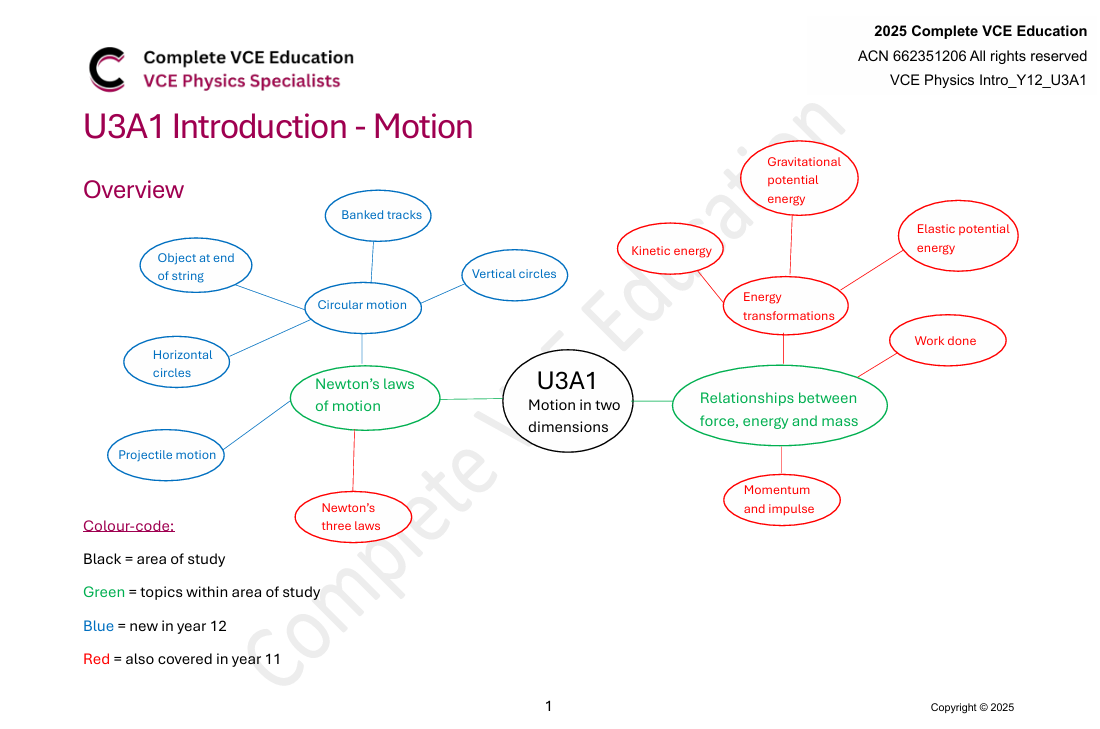
Here, I will summarise the changes to units 3&4 of VCE physics. The main changes include the movement of the motion topic from AOS 3 to AOS 1 of unit 3, the merging of unit 4 AOS 1 and 2, and the movement of Einstein’s special relativity to unit 4 AOS 1. Some minor changes to content have also been made (eg. removal of refraction, addition of photovoltaic cells). It is important to note that since AOS 3 has been removed from unit 4, the number of SACs throughout the year will be reduced from six to five.
Unit 3 AOS 1: How do physicists explain motion in two dimensions? (Unit 3 AOS 3 in previous study design)
Some content moved to unit 4 AOS 1, but nothing added
Removed:
- Einstein’s theory of special relativity, time dilation, length contraction
- Einstein’s mass-energy equivalence
Kept:
- Newton’s laws of motion
- Circular motion
- Projectile motion
- Relationships between force, energy and mass
- Work done and energy transformations
- Impulse and momentum
- Kinetic energy, elastic potential energy and gravitational potential energy
Unit 3 AOS 2: How do things move without contact? (Unit 3 AOS 1 in previous study design)
Basically the same, but with one small addition.
Added:
- Investigate, qualitatively, the effect of current, external magnetic field and the number of loops of wire on the torque of a simple motor
Kept:
- Fields and interactions (gravitational, electric, magnetic)
- Effects of fields (forces, work done, energy changes)
- Application of field concepts (satellite motion, magnetic forces on current carrying conductors, DC motors, particle accelerators including synchrotrons)
Unit 3 AOS 3: How are fields used in electricity generation? (Unit 3 AOS 2 in previous study design)
Added:
- Production of electricity using photovoltaic cells, need for an inverter to convert power from DC to AC for use in the home
Removed:
- Convert between rms, peak and peak-to-peak values of voltage and current
- Identify the advantage of using AC power as a domestic power supply
Kept:
- Magnetic flux
- Faraday’s Law
- Lenz’s Law
- DC and AC generators
- Power transmission and losses
- Transformers
Unit 4 AOS 1: How has our understanding of the physical world changed? (Unit 4 AOS 1 and 2 of previous study design combined)
Added:
- Discuss the importance of quantisation in the development of knowledge about light and in explaining the nature of atoms
- Einstein’s special theory of relativity, time dilation, length contraction (formerly part of Unit 3 AOS 3)
- Interpret null result of Michelson-Morley experiment as evidence in support of Einstein’s special theory of relativity
- Examples of special relativity: muons, particle accelerators, GPS satellites
- Einstein’s mass-energy equivalence (formerly part of Unit 3 AOS 3), including mass conversion in sun, positron-electron annihilation and nuclear transformations in particle accelerators
Removed:
- Properties of mechanical waves
- Doppler effect
- Formation of standing waves where only one end is fixed
- Refraction and dispersion (moved to Unit 1 AOS 1)
- Polarisation
- Regions of electromagnetic spectrum and uses in society (moved to unit 1 AOS 1)
- Describe the quantised states of the atom with reference to electrons forming standing waves, and explain this as evidence for the dual nature of matter
- Heisenberg’s uncertainty principle
- Explain why classical physics are not appropriate to model motion at very small scales
Kept:
- Explain and analyse the formation of standing waves (nodes at both ends only)
- Light as a wave
- Young’s double slit experiment (path difference, interference, fringe separation)
- Diffraction (λ/w ratio)
- Photoelectric effect
- Matter as particles or waves (de Broglie wavelength, electron diffraction patterns)
- Absorption and emission spectra
- Single photon and electron double slit experiments
Unit 4 AOS 2: How is scientific inquiry used to investigate fields, motion or light? (Unit 4 AOS 3 in previous study design)
The practical investigation is essentially the same, with some minor changes to the study design.
Added:
- Repeatability (instead of reliability), reproducibility, resolution
- Physical significance of the gradient of linearised data, use of uncertainty bars, assumptions
Kept:
- Investigation design (methodology, physics concepts, health and safety guidelines)
- Identify and explain observations and experiments that are consistent with or challenge current models or theories
- Accuracy, precision, validity
- Discuss the nature of evidence that supports or refutes a hypothesis, model or theory
- Primary data, error, uncertainty, limitations
- Model the scientific practice of using a logbook to authenticate generated primary data
- Science communication and conventions
Once again, please have a read of the new study design for yourself, and keep referring to it regularly throughout the year to ensure that you are covering all the content required. I recommend using the study design as a checklist and ticking off each dot point once you have covered that point. In addition, if you are making summary notes, you may find it useful to structure your notes according to the study design. If you haven’t already, I highly recommend that you have a read of our other articles with our tips for success in VCE physics. Best of luck with your VCE physics studies!


