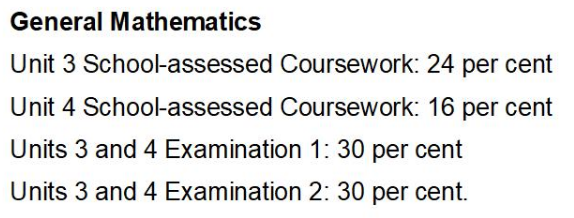
Your final VCE General Maths study score isn't just a simple average of your marks; it is a weighted ranking compared to every other student in the state. To arrive at your final score out of 50, VCAA looks at three primary Graded Assessments (GAs):
- Unit 3 School Assessed Coursework (24%): Your Unit 3 SACs make up a significant portion of your grade. Note that these are statistically moderated by VCAA based on your cohort's exam performance to ensure a level playing field across different schools.
- Unit 4 School Assessed Coursework (16%): Your Unit 4 SACs make up a slightly less significant portion of your total grade. Unlike the other VCE Mathematics subjects, they are curiously not weighted to the nearest ten, but rather a 16/24 split to a total of 40% for your SACs.
- Examination 1 (20%): This 1-hour, technology-free exam tests your ability to solve problems using algebraic fluency and mental logic without a CAS calculator or notes.
- Examination 2 (40%): The 2-hour, technology-active exam allows for the use of your CAS calculator and a bound reference. This paper focuses on the application of concepts to complex, extended-response scenarios.
Once your raw scores are combined according to these weightings, they are mapped onto a normal distribution curve (the "bell curve"). A score of 30 represents the state average, while a score of 40 or above places you in the top 9% of all Victorian students. Since the study score is a reflection of your rank rather than just your percentage, consistent performance across both your school SACs and the final external exams is the key to a raw 40+ result.