




.png)

.png)


.png)















2026 Complete VCE Education.
All rights reserved
VCE Chemistry Study Design - Essential Curriculum Insights
Looking for the current VCE Chemistry Study Design? Access our syllabus PDF, explore key knowledge across Units 1–4, and read expert tips to achieve a 40+ study score.
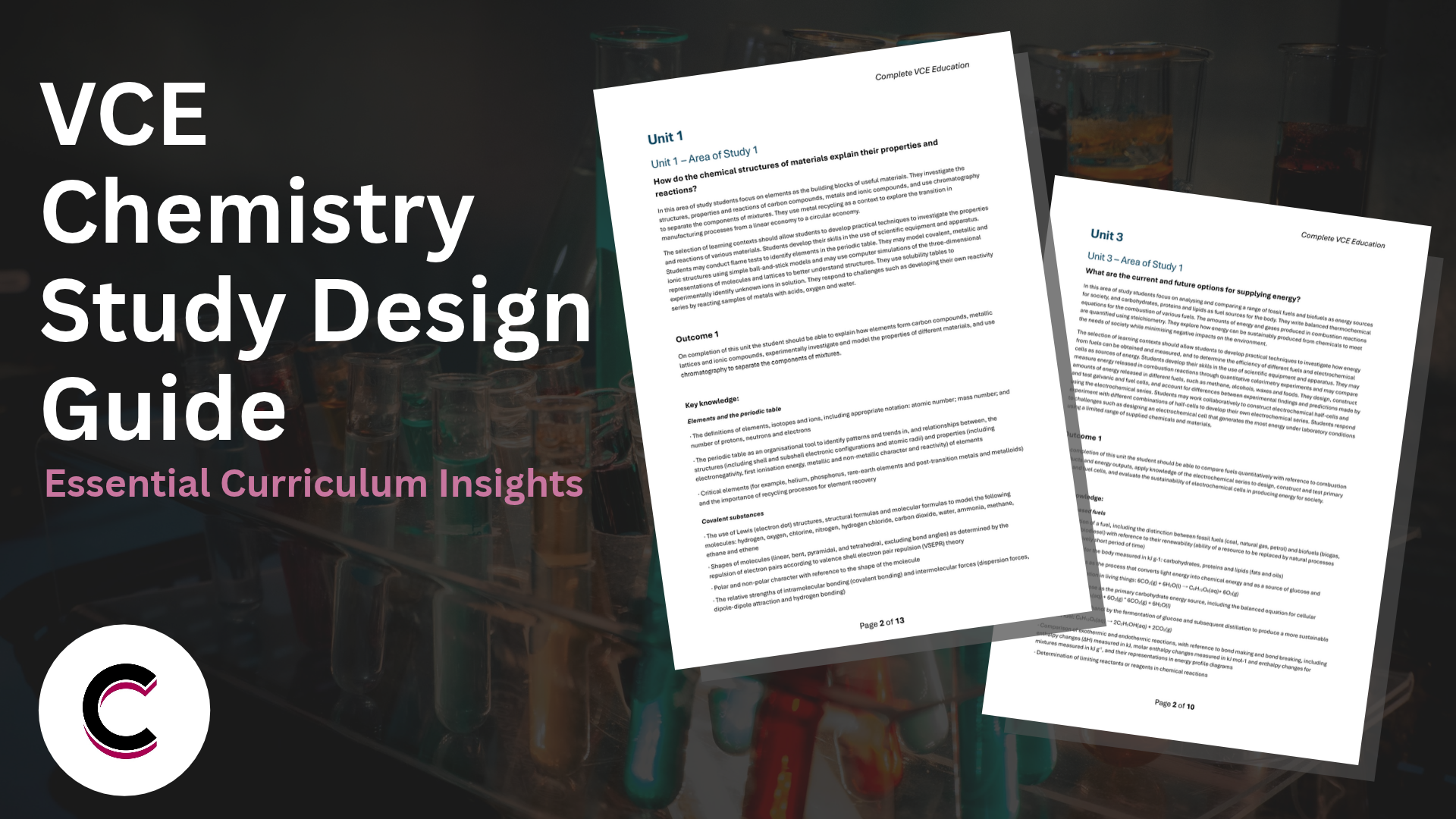
Looking for the current VCE Chemistry Study Design [source: 1]? Access it directly below to review assessed topics, clarify key knowledge points, and understand how the course is structured across Units 1 to 4.
Whether you are starting Unit 1 or Unit 3, preparing for your school-assessed coursework (SACs), or gearing up for the end-of-year examination, understanding the official study design is the single most effective way to align your revision with what VCAA actually rewards. From galvanic cells, equilibrium systems, and energy production to organic reaction pathways, instrumental analysis, and medicinal chemistry, the syllabus dictates every mark on the final exam. Knowing what the examiners expect is your first step toward achieving a 40+ or 50 study score.
Download the study design at the links below as a roadmap for your VCE Chemistry journey:
- VCAA VCE Chemistry Study Design Units 1 and 2 [PDF]
- VCAA VCE Chemistry Study Design Units 3 and 4 [PDF]
Moving Beyond Average in VCE Chemistry
Chemistry is often perceived as a content-heavy memory test, but high-scoring students know that memorisation alone will not earn high marks in VCAA exams.
While definitions and chemical formulas are fundamental, the examiners deliberately construct questions that test conceptual application, scientific reasoning, and mathematical precision:
- Multi-Step Quantitative Chemistry: Stoichiometry rarely appears as a standalone, one-step question. Exam questions integrate mole concepts into titrations, calorimeter calibration factors, Faraday's laws in electrolysis, and equilibrium constant, quotient evaluations.
- Mechanism & Pathway Design: Rather than just identifying organic functional groups, students must map multi-stage synthetic reaction routes, predict structural isomers, interpret Hydrogen-1 NMR and Carbon-13 NMR spectra, and explain reaction conditions such as catalysts and temperature trade-offs.
- Experimental Rigour: VCAA places immense weight on scientific inquiry. You must be able to design valid controls, calculate percentage uncertainty, distinguish between random and systematic errors, and evaluate how experimental design impacts accuracy and precision.
Conquer VCE Chemistry with Victoria's Leading VCE Science and Maths specialists
Achieving a 40+ study score in Chemistry requires targeted feedback, rigorous SAC preparation, and an understanding of examiner marking schemes.
Whether you want to refine your understanding of equilibrium, conquer organic spectral analysis, or sit practice SACs curated by top-tier educators, our specialised VCE programs give you the edge.
Why Complete Education?
- Raw 50 & 99+ ATAR Mentors: Be taught by experienced educators and high-achieving VCE Chemistry graduates who know what examiners look for.
- Extensive Resource Vault: Seen our free resources? Gain access to our complete library of practice SACs, worked solution booklets, and revision cheat sheets.
- In-Person & Online Options: Join our interactive small-group classes at our Melbourne tutoring centre or access live online tuition from home.
Ready to embark on your jouney to a raw 40+ in VCE Chemistry?
Discover Our top-class VCE Chemistry Tutoring Program (Melbourne & Online)


