




VCE Physics - The Michelson-Morley Experiment Explained

VCE Physics - A full explanation of the famous "failed experiment" accompanying our YouTube video on the same.
Written by
Asel Kumarasinghe
Published on
February 5, 2025

Background

In the 19th century, physicists developed various theories regarding the nature of light. One physicist, James Clerk Maxwell, developed a set of four equations which became the foundation of electromagnetism. His equations predicted that light is an electromagnetic wave that propagates at a speed of 3.0 × 10⁸ m s-1 in a vacuum. However, the strange part which baffled physicists at the time was that the equations also implied that the speed of light was constant and independent of the motion of the source or the observer.

This was contrary to classical physics and Galilean relativity, which suggested that the speed of light should depend on the relative motion of the source and the observer. For example, if a star is emitting light at a speed of 3.0 × 10⁸ m s-1 and a spaceship is moving towards the star at 1.0 × 10⁸ m s-1, then according to classical physics, the speed of the light emitted by the star relative to an observer in the spaceship should be 4.0 × 10⁸ m s-1. However, according to Maxwell’s equations, the speed of light when measured from the spaceship would still be 3.0 × 10⁸ m s-1.

To reconcile this, most physicists believed that the constant speed of light predicted by Maxwell's equations was the speed of light relative to a medium. They called this hypothetical medium of light the “aether”. This idea arose from the fact that mechanical waves such as sound, earthquake and water waves require a medium for propagation, so they believed that light waves must also require a medium. Due to light's ability to travel through a vacuum, they believed that space must be filled with this so-called aether. However, the aether was purely hypothetical and no evidence had been found to support it.

The Michelson-Morley Experiment

If the aether really did exist, Earth must be moving through it. As the Earth moves through the aether, which was assumed to be stationary in space, an “aether wind” would be passing in the opposite direction. It was presumed that light travelling in the direction of Earth’s velocity would be slowed down as it is travelling against the aether wind, so it would have a slower apparent speed (c - v, where v is the velocity of the Earth relative to the aether). Conversely, light travelling opposite to Earth’s motion would be travelling with the aether wind and appear faster (c + v).

A still from our YouTube video on this topic

In 1887, physicists Albert Michelson and Edward Morley developed an experiment with the aim of measuring the velocity of Earth relative to the aether. Their experiment was based on the idea that light travelling parallel to Earth’s velocity through the aether would be slowed down compared to light travelling perpendicular to Earth’s velocity.

They set up a device called an interferometer, which splits a light beam into two perpendicular paths before recombining them to form an interference pattern.

A snippet of the interferometer animation from our video.

Here’s how it works: a light source projects a beam of light towards a 45° half-silvered mirror. This mirror splits the light into two beams:

  • Beam A travels in the direction of the supposed aether velocity, reflects, and returns to the interferometer.
  • Beam B travels in a plane perpendicular to the aether velocity, reflects off another mirror, and returns to the interferometer.

The two beams recombine, creating an interference pattern of bright and dark regions. To test for the presence of the aether, the apparatus is rotated 90 degrees. If the aether existed, the velocities of Beams A and B would change, resulting in a sideways shift in the observed interference pattern, which was the expected result.

However, no shift in the interference pattern was observed when the apparatus was rotated 90 degrees; a null result (i.e. a negative result). This meant the speeds of beams A and B were unchanged when the apparatus was rotated, suggesting that the speed of light was the same in both directions.

Significance

Although the experiment did not directly disprove the aether model, it failed to provide evidence to support the aether’s existence. It suggested that light does not require a medium for propagation, and that the speed of light is constant in all directions. Therefore, it encouraged physicists to explore other theories, notably Einstein’s special theory of relativity, which proposed that:

  • The aether does not exist and is not necessary for light to propagate.
  • The speed of light is constant, regardless of the observer's motion or reference frame.

Therefore, despite being labelled as the “most famous failed experiment”, the null result of the Michelson-Morley experiment is ultimately significant as it provides evidence in support of Einstein’s theory of special relativity, which greatly influenced modern physics.

VCE Sample Question and Explanation:

Question:

Michelson and Morley devised an experiment with the aim of measuring the velocity of Earth relative to the aether. They observed the fringe pattern at a detector resulting from interference between two light beams, one travelling parallel to Earth’s velocity and the other travelling perpendicular to it. The measurement was then repeated with the apparatus turned through an angle of 90°, and no change was seen in the interference-fringe pattern.

Explain the significance of this null observation. (3 marks)

Answer: found here

Full Animated Explanation of The Experiment:

Free VCE Science and Maths Resources
No spam. Just the latest blogs and tips, practice questions, and exclusive guides directly to your inbox - no strings attached.
We care about your data in our privacy policy.
Thank you! Your submission has been received!
Oops! Something went wrong while submitting the form.

Interested in more?

Take a read through our most recently published blogs...
NAPLAN Resources

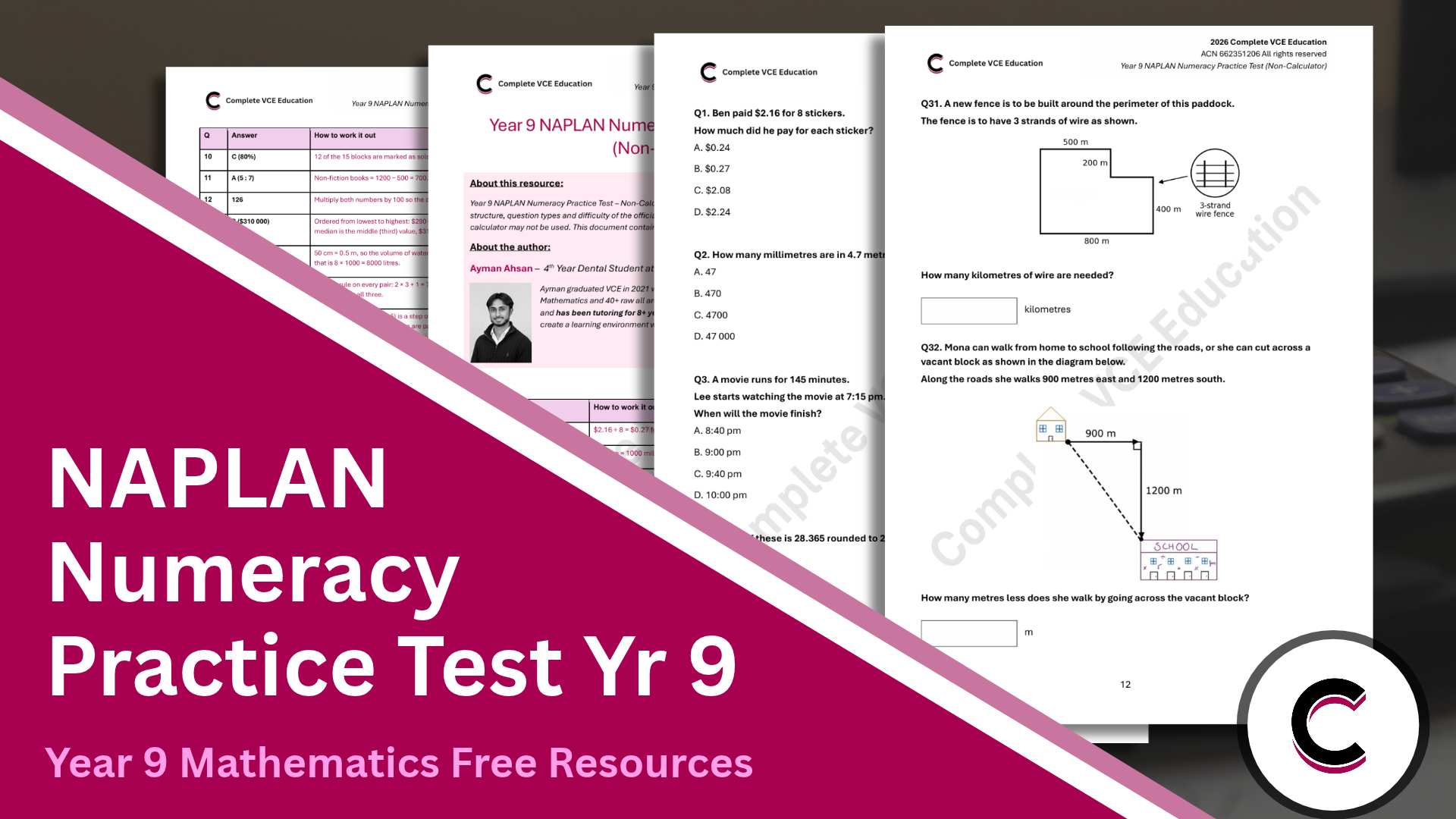
Year 9 NAPLAN Numeracy Free Practice Test & Solutions

Looking for a Year 9 NAPLAN Numeracy practice test with worked solutions written by expert secondary tutors? We've got you covered.
Ayman Ahsan
October 24, 2026
•
7
min read
VCE Maths Methods Resources

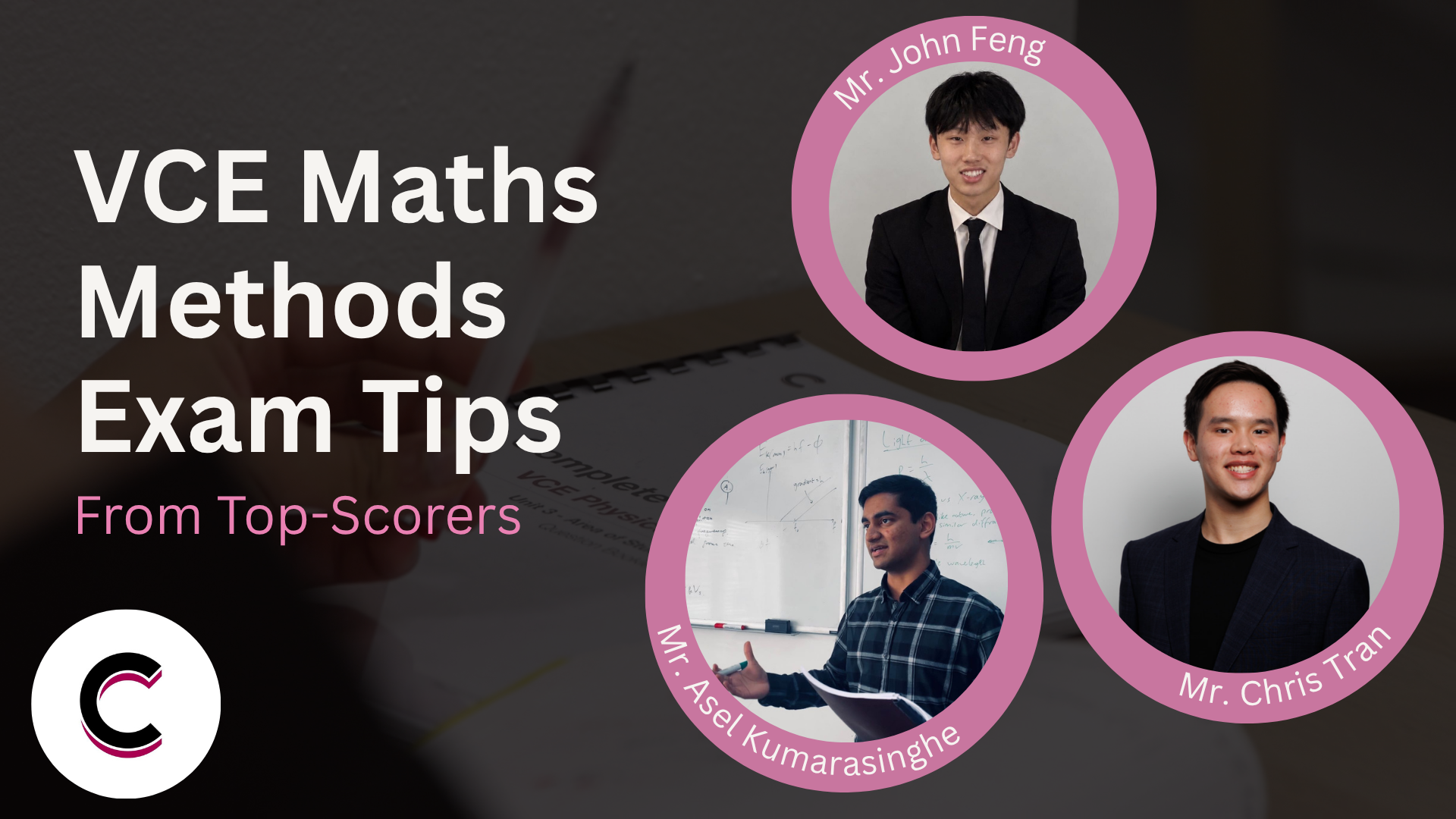
VCE Maths Methods Exam Tips - 6 Simple Strategies from Raw 50 Scorers

Learn exactly what three top-scoring Maths Methods tutors did to conquer the final VCAA exam and rank among the state's best.
Asel Kumarasinghe
October 16, 2026
•
8
min read
NAPLAN Resources

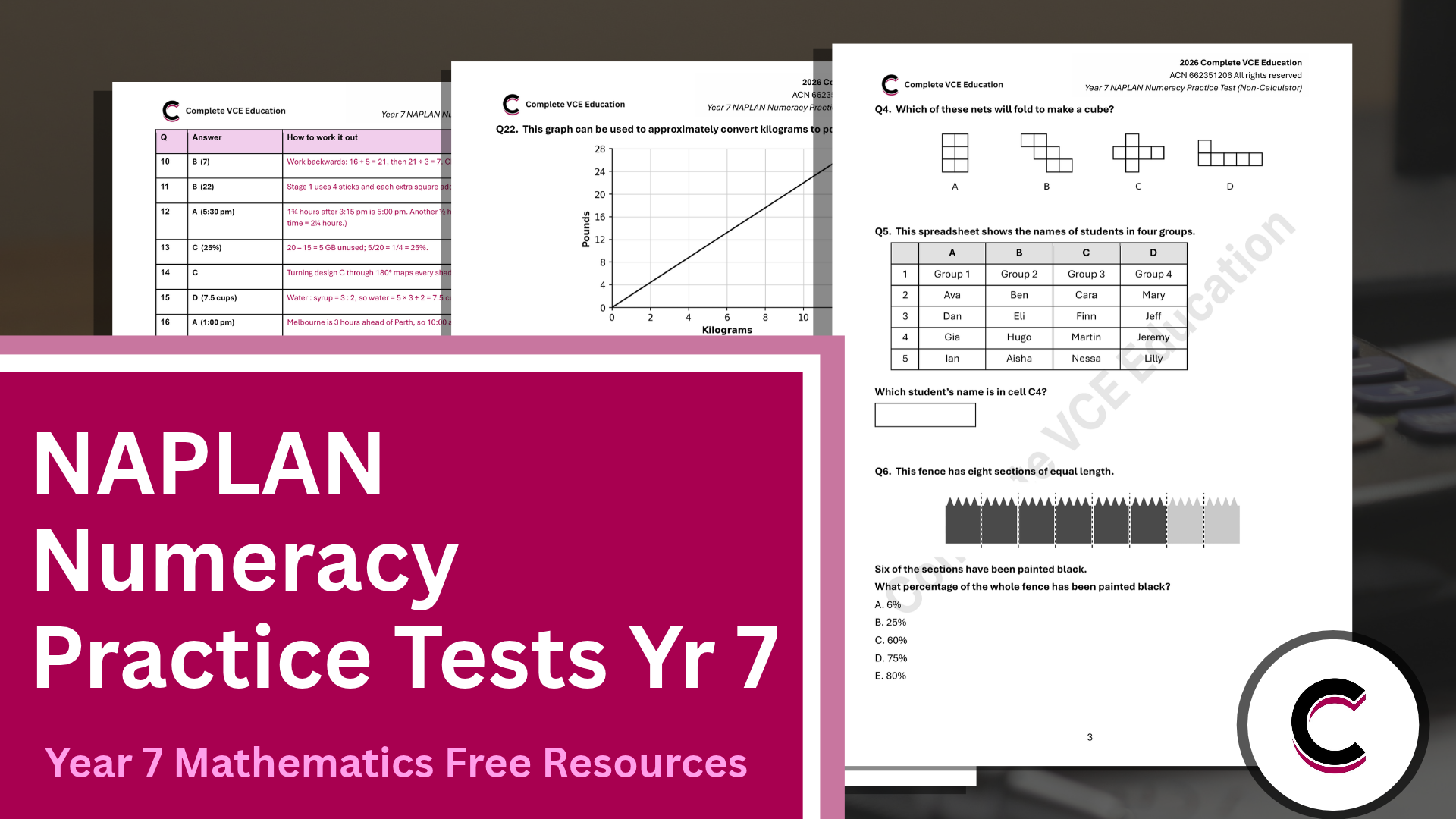
Year 7 NAPLAN Numeracy Free Practice Test & Solutions

Download our two free, full-length Year 7 NAPLAN Numeracy practice tests (Calculator Allowed & Non-Calculator) with comprehensive worked solutions written by expert secondary maths tutors — no email or sign-up needed.
Ayman Ahsan
October 3, 2026
•
6
min read
NAPLAN Resources

Year 5 NAPLAN Numeracy Free Practice Test & Solutions

Access our Grade 5 NAPLAN Numeracy practice test with worked solutions written by expert primary tutors —no email or sign-up needed.
Ayman Ahsan
September 24, 2026
•
6
min read
NAPLAN Resources

Year 9 NAPLAN Numeracy Free Practice Test & Solutions

Looking for a Year 9 NAPLAN Numeracy practice test with worked solutions written by expert secondary tutors? We've got you covered.
Ayman Ahsan
October 24, 2026
•
7
min read
VCE Maths Methods Resources

VCE Maths Methods Exam Tips - 6 Simple Strategies from Raw 50 Scorers

Learn exactly what three top-scoring Maths Methods tutors did to conquer the final VCAA exam and rank among the state's best.
Asel Kumarasinghe
October 16, 2026
•
8
min read
NAPLAN Resources

Year 7 NAPLAN Numeracy Free Practice Test & Solutions

Download our two free, full-length Year 7 NAPLAN Numeracy practice tests (Calculator Allowed & Non-Calculator) with comprehensive worked solutions written by expert secondary maths tutors — no email or sign-up needed.
Ayman Ahsan
October 3, 2026
•
6
min read
NAPLAN Resources

Year 5 NAPLAN Numeracy Free Practice Test & Solutions

Access our Grade 5 NAPLAN Numeracy practice test with worked solutions written by expert primary tutors —no email or sign-up needed.
Ayman Ahsan
September 24, 2026
•
6
min read

Frequently Asked Questions:

Got a question about our services? Take a look at some of the most common questions we get asked below for an instant answer.
General Queries
What subjects do you offer?
Do you offer online or in-person tutoring?
Most of our classes are delivered in a hybrid format (combined in-person and online). Our in-person classes are conducted at our office located at 206/343 Little Collins St, Melbourne VIC 3000, which is only a 5-10 minute walk from Flinders Street Station. Students may also choose to attend our classes via Zoom.
How do I enrol? Can I try a lesson before committing?
We offer a trial lesson to all new students to experience the quality of our tutoring and see if it is right for them. The trial lesson is free of charge if the student chooses not to continue with us. If the student is satisfied with the trial lesson, we will send through enrolment and payment details. Trial lessons can be scheduled here:
Book a Trial Lesson
What class streams are available and what resources are provided?
The Core stream, which is our most popular option, consists of weekly 2-hour dual-delivery (face-to-face or online) group classes with one of our experienced tutors, with features such as our extensive question bank (3000+ questions) and notes, raw 50 differentiator questions and walkthrough, mock SACs and 24/7 online support via Discord. 

The Enrichment stream consists of weekly 2-hour dual-delivery (face-to-face or online) group classes. It has the same features and covers the same content as the Core stream, except that it is a select entry program with accelerated pacing designed to support high achieving students who are aiming for top study scores. Selection for this stream is based on recent SAC results for that particular subject.

*Note: Differing core/enrichment streams are currently only available for our premiere subject offering - VCE Physics
Classes
What lesson times are available?
Our available lesson time slots can be found here across all our subjects:
Class Timetable
Are lessons one-on-one or in groups?
At this stage, we only offer group classes. While we do not offer one-on-one classes, students will receive 24/7 out-of-class support from our experienced tutors via our Discord server. Students can also book free 15 minute academic consultations with our tutors leading up to SACs or exams in order to receive more personalised support. 
How many students are in each class?
Class sizes can range from 5-20 students, with students joining both online and in-person. If the student prefers smaller class sizes, there are different class options available.
What happens during a typical lesson?
Our lessons are structured according to the current VCAA study design, with each lesson covering a different aspect of an area of study. A typical lesson will commence with theory embedded with example questions, and then time set aside for students to work on practice questions and ask for assistance if necessary. Lessons are typically interactive, fostering student engagement while providing opportunities for students to ask questions if they require further clarification.
Do lessons run during school holidays?
Yes, for some subjects and year levels we will run lessons during school holidays. For example, the year 12 physics program will have classes during January to enable students to get a headstart with the content.
Our teaching calendars for all our subjects can be accessed via this link:
Class Timetable
Student Support
What if I miss a lesson?
Each week, we send out full lesson recordings, notes and homework solutions to all enrolled students. If a student is unable to make a lesson, they will be able to either attend a different class in the same week or catch up with the recording. If the student requires additional assistance, they are able to contact us via our Discord server. If students are no longer able to attend their normal time slot, they are welcome to change to a different available time slot.
What support is available for students prior to SACs and exams?
We offer 24/7 online support via our Discord server. Once you enrol with us, you will be able to join and ask us any questions you have. Our experienced tutors will answer your questions swiftly. We also have specific lessons allocated for SAC preparation and run mock SAC sittings. The mock SACs completed in class are marked by us and we also run SAC walkthrough sessions. All of this support is designed to empower students to excel in school SACs and exams. 
How is student progress tracked? Will parents receive progress updates?
We run invigilated mock SACs for each area of study, as well as mock exams at the end of the year, which enables tracking of student progress throughout the year. Students send us their completed paper and our tutors will mark and return it to them. We also provide general feedback and statistics to both students and parents on SAC and exam performance across the student cohort.
How can students and parents contact tutors outside lessons?
Students may contact us via our email address (completevceeducation@gmail.com) or contact our tutors via our Discord server for 24/7 support. Parents may contact us via our email address. Additionally, tutor phone numbers will be provided for students and parents who wish to contact our tutors directly.
Pricing and Fees
How much does tutoring cost?
Pricing will vary depending on the subject and year level. Pricing information is available on the top panel under ‘pricing’. At this stage, we only accept termly or full year payments.
Do you offer discounts?
Yes! We offer two discounts:
- 10% off full-year enrolments at the start of the year*
- 15% off the next term payment if you refer a friend

*Full-year payments are non-refundable