




2026 Complete VCE Education.
All rights reserved
High-Achiever VCE Study Techniques - Spaced Repetition and Active Recall
Wondering how high achieving VCE tutors obtained their scores? Learn two of the most powerful study techniques from Victoria's top VCE Physics and Methods specialists.
Ever wondered how exactly we should study? How about how high achieving students study?
These are questions that many of us have likely wondered when receiving a bad grade, an unexpected assessment outcome or even by those looking to get ahead of their classmates in SAC ranking. Many turn to question their study habits or methods in seeking to do better - and for good reason; we have the greatest control over this single aspect of our schooling.
While study methods can be a very personal thing, there are more often than not, tried-and-true techniques that elevate students to academic success. As the title of this blog post suggests, we will be diving into some of the most prominent yet effective study techniques from some of Melbourne’s top VCE tutors, as they draw on their own experience not only from their personal time during the final years of high school, but also from their real-world observations through guidance of their own students.

The Power of Spaced Repetition
Mr. Asel
(99.95 ATAR, Doctor of Medicine Student at UniMelb, Head of Resources at Complete)
Many VCE students struggle with remembering key details for content-heavy subjects such as biology or chemistry. I initially struggled with this as well during the early stages of my Biomedicine degree - the sheer amount of information one needs to learn before an exam can become overwhelming. However, I realised that my poor retention of facts was primarily due to the fact that I was not consistent with my revision, leaving the majority of it to the days before an exam. If I had started my revision much earlier and was more consistent, I would be better able to retain and understand the content.
It was then that I realised that the key to long-term retention is spaced repetition – the idea that by constantly reviewing and revising content at regular intervals, the content will be more firmly cemented and committed to long-term memory. This is beautifully illustrated by Hermann Ebbinghaus’ “forgetting curve” – a concept that is still applicable to the present day. It is the idea that the rate at which we forget information is the greatest after we learn it for the first time. However, if we consistently review the content at spaced intervals, the rate at which we forget the content is slowed, leading to better long-term retention.
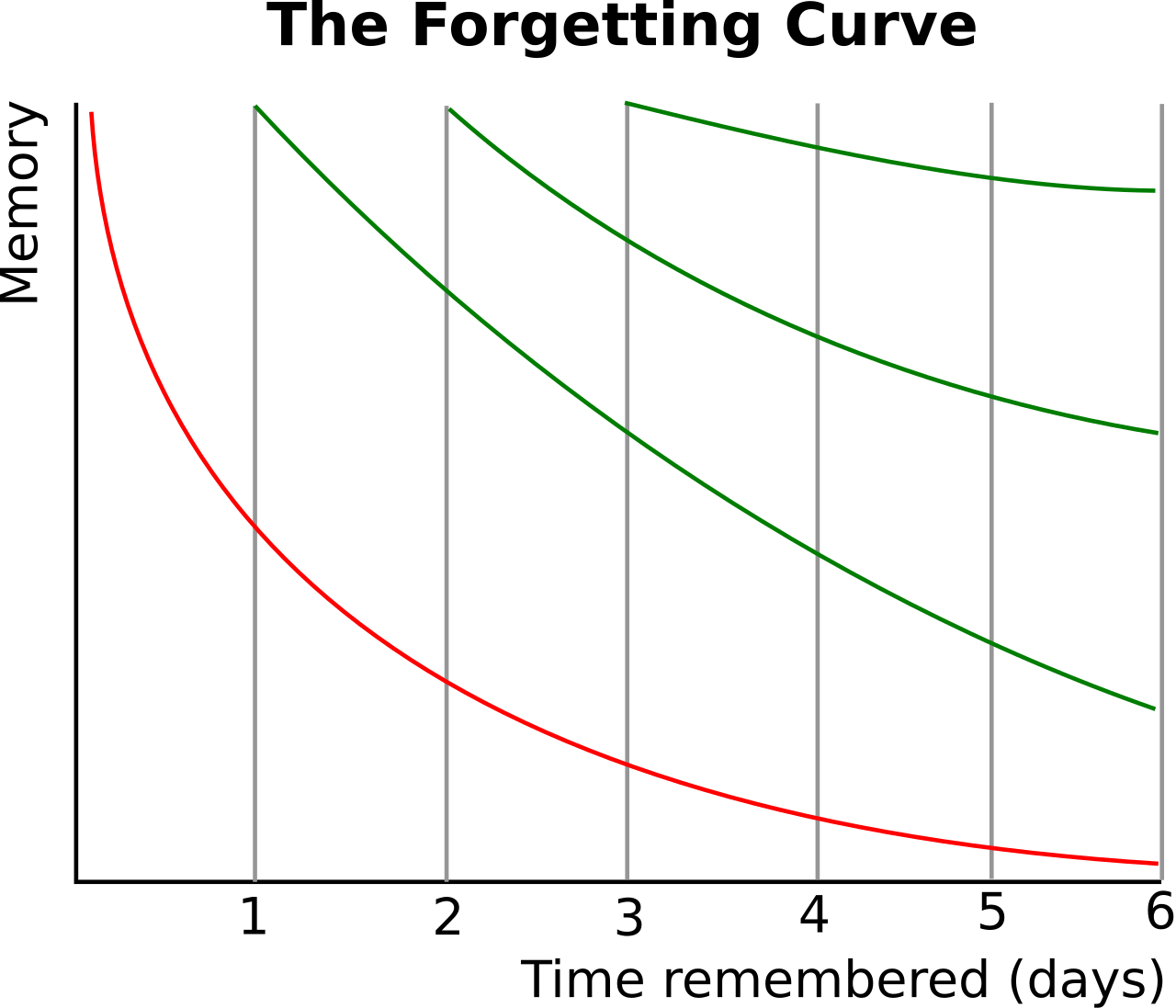
As the curve above shows, through repeated reviews of newly-learned content, we can slow down the rate at which we forget the content, highlighting the power of spaced repetition especially when revising for exams. This also underscores the ineffectiveness of cramming everything a few days before an exam, as it is likely that on exam day, you will have forgotten most of what you had crammed.
A personal strategy that I found useful for memorising information in my Biomedicine and Medicine degrees is Anki, which is an online flashcard program. Anki incorporates spaced repetition, such that reviews are automatically scheduled at regular intervals, with the review interval determined by the difficulty of the card. For example, a more difficult card that you often answer incorrectly has shorter review intervals compared to an easier card that you often answer correctly. Therefore, Anki greatly helps to provide a framework to enable spaced repetition, aiding retention for content-heavy subjects. Ultimately, spaced repetition has helped me immensely to succeed in both my Bachelor of Biomedicine and Doctor of Medicine degrees.

"Just do more questions"
Mr. Logan
(99.70 ATAR, Student Dentist, VCE Physics Tutor)
Spaced Repetition Studying, Pomodoro and other advanced study techniques can certainly be incredibly helpful for the right individual when it comes to VCE preparation. However, speaking from personal experience, my routine followed the simple, albeit primitive philosophy of 'just do more practice' rather than an explicit study regiment.
Your brain learns best when new neural pathways are formed through testing of recall, active problem solving, theory application and the morphing of multiple concepts in a single problem. Each of these examples are all essentially the same thing - trying something new each time rather than simply glossing over a static set of notes that is not truly pushing yourself further.
This is of course, easy to realise for STEM based subjects such as VCE Physics or Mathematics but it even extends over to VCE English and the humanities; the concepts stay identical. Whether it be long-form scenario questions, essays on unique topics or argument analyses of various opinion pieces, testing yourself in constantly new ways is a near-requirement of academic success in VCE.
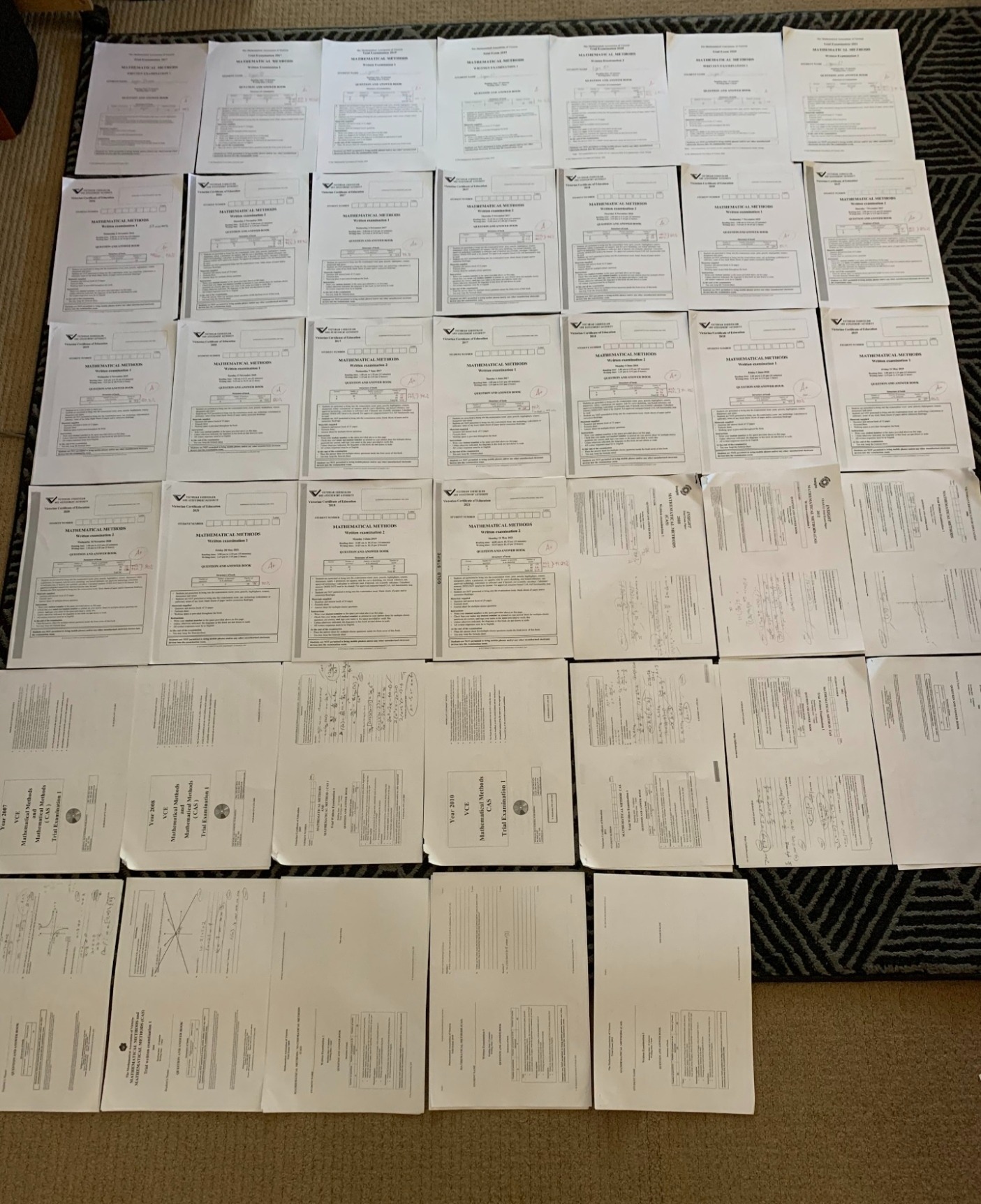
In a way, this straightforward concept ties closely into passive vs active recall, despite my initial rejection of specific study techniques. Both this ‘philosophy’ and active recall stress the importance of study by doing rather than absorbing like a human sponge.
Now this is not to say that you are required to complete every past VCAA paper for every one of your subjects in order to do well (though that would certainly be most ideal) as it’d be unrealistic for every student to have not only the immense time free to do so, but also the motivation to avoid burnout (an arguably larger detriment to your results!) partway through.
While school teachers, resources available and tutoring certainly provided a healthy boost, I firmly believe that the amount of real practice completed is the ultimate determinant to one’s VCE outcome. If it weren’t for this, I cannot say that I would be confident in achieving a 99.70 ATAR and making it into my dream course - Bachelor of Dental Science.
Active vs Passive Learning
Dr. Raphael
(Registered Doctor, 99.90 ATAR, 7+ Yrs of VCE Tutoring Experience, Complete VCE Education Founder)
Would you consider each of the following scenarios to be passive or active learning?
Scenario 1: lectured-style teaching with a power point presentation.
Passive
Scenario 2: Doing homework questions after class.
Active
Scenario 3: Reading over lesson notes repeatedly to memorise content in preparation for a test.
Passive
Scenario 4: Flash cards. In a Q&A format where the question is presented on the front of the card, and the answer is on the back.
Active. This requires you to actively think about the solution to the question prior to checking the answer. It is especially good for memory-heavy, rote-learning type study.
Scenario 5: What about this quiz you’re doing now? Is this an active or a passive type of learning?
You guessed it. Active! Notice your ability to immediately better comprehend the distinction between the two by actively thinking through each option. That’s the power of active learning.
Now I want you to imagine two students. Let's call them Student A and Student B...
Student A and student B who both enrol into a physics course having previously studied no physics at all.
Student A’s curriculum requires them to learn theory in class every week, with minimal practice questions or mock exams, except for 1 final mock test at the end of the year.
Student B’s course, on the other hand, teaches absolutely no theory! Students do nothing but sit 1 full 3-hour paper under exam conditions at the start of every week with feedback and answers provided through the week.
I can guarantee you that even though for the first 10, or even maybe 20 weeks, student B’s test results may be horrendous. By 52 weeks, starting with zero knowledge, student B will be outscoring student A every single week on the mock exam. That’s because student B utilised highly stimulatory end-goal based active learning. Which is something Complete VCE Education employs and believes in truly.
I had a student a few years back. They stayed behind in a zoom class and asked me one day: “Raph, I got a biology final exam coming up, I don’t feel very prepared for it, but I only have about 2 weeks left that I spend dedicated entirely toward its preparation. Do you have any advice to give me?” I thought for 5 seconds and replied simply: “past papers.” I had instructed him to go through as many papers as he had time for before the final exam. And he did. At the end, he scored a 43 raw for biology, and one of his best subjects that year!
That's why here at Complete VCE Education, we place such an emphasis on active learning and active recall via:
- Q and A style approach to teaching students theory
- Using stories and examples to illustrate ideas
- Ample number of in-class practice questions with direct tutor assistance and oversight
- A massive vault of homework questions, ensuring students never run out of practice
- Access to 24/7 direct tutor support through our Discord server
That's why our students reach their academic potential, with Complete graduates such as Megan Tan attaining a Raw 50 amongst an abundance of Raw 40s. Conquer VCE Physics and VCE Maths Methods with tutoring from our team of 99+ ATAR, Raw 50 tutors and master spaced repetition and active recall study techniques.


